


Content
- 1 What Functional Additives Actually Control in a Powder Coating
- 2 Functional Additives: Five Job Families in One Formula
- 3 Curing Agents: The Functional Additive That Defines the Resin
- 4 Outdoor HAA Systems: Where Additive Choice Changes the Process Window
- 5 Hybrid Systems: Epoxy Acting as a Functional Additive
- 6 Loading Windows: Where Cost, Risk and Performance Sit
- 7 Matching Functional Additives to Curing Chemistry
- 8 Indoor Versus Outdoor: Two Different Additive Priorities
- 9 Application Scenarios Where Additive Priorities Shift
- 10 Specification Windows Worth Writing Into a Contract
- 11 Processing Guidance: Extrusion, Grinding and Cure
- 12 Troubleshooting Functional Additive Faults
- 13 Choosing a Polyester Resin Manufacturer, Supplier or Wholesale Partner
- 14 Next Step: Custom Resin Development
A coater running a 60:40 hybrid polyester at 180 °C for 15 minutes still sees pinholes on 1.2 mm cold-rolled steel. The resin certificate matches the batch, the pigment has not changed, and the oven curve is logged and clean. In most of these cases the answer is not the resin at all. It is the functional additive package sitting on top of it.
The conclusion first: in a thermoset powder coating, functional additives are not seasoning thrown in at the end of the formula. They set the process window, the defect rate and the service life of the film, and they do it at loadings between 0.05% and 10%. Get crosslinker stoichiometry right and the rest of the formula becomes predictable. Get the degassing agent wrong by 0.2% and a perfectly sound polyester resin will be blamed for pinholes it did not cause.
This guide is written from the position of a polyester resin manufacturer that supplies formulators, coaters and wholesale partners. It covers what functional additives actually do, how they interact with hybrid, TGIC, HAA and isocyanate curing chemistry, which windows are worth writing into a purchase specification, and where the practical risks sit during extrusion, application and service.
Functional additives are cheap by weight and decisive by outcome; the additive package, not the resin alone, defines whether a powder line runs at 92% first-pass yield or fights the same defect every shift.
What Functional Additives Actually Control in a Powder Coating
Strip a powder coating back to its components and four groups remain: the binder, the pigment, the filler, and the functional additives. The binder — polyester, epoxy, or a blend of the two — forms the continuous network. Pigments give colour and opacity. Fillers such as barium sulphate or calcium carbonate adjust cost, density and mechanical bulk. Functional additives are everything added in small fractions to change how the other three behave.
The word "functional" is doing real work here. A pigment changes what the film looks like; a functional additive changes what the film does. It can alter melt viscosity during cure, surface tension at the substrate interface, the speed at which carboxyl and epoxy groups find each other, the rate at which ultraviolet energy breaks polymer chains, or the way powder particles accept charge in the gun.
Powder coatings impose a constraint that liquid coatings do not. Every additive must be a solid or a melt-dispersible masterbatch at room temperature. It has to survive extrusion at 90 °C to 120 °C for 30 to 60 seconds without reacting with the resin, and then it has to do its job during cure at 140 °C to 200 °C without volatilising into oven fog. Anything that cannot meet those two conditions is not usable in powder, regardless of how well it performs in a solvent-borne system.
That constraint explains why the powder additive palette is narrower than the liquid one and why small errors travel further. There is no solvent to carry an additive to the surface, no post-add stage to correct a mistake, and no way to re-disperse a settled ingredient. The additive has to be in the right place, at the right concentration, from the moment the flake is ground.
It also explains why the additive package influences the whole production chain rather than just the cured film:
- During compounding, rheology modifiers decide extruder torque, die build-up and whether the flake crumbles cleanly.
- During application, charge modifiers and particle surface additives decide transfer efficiency and film build uniformity.
- During film formation, flow agents, degassing agents and catalysts decide whether the melt levels out and whether air escapes before the gel point.
- During service, stabilisers, waxes and crosslinkers decide gloss retention, chalking, hardness, chemical resistance and adhesion after ten years outdoors.
In powder coatings the additive package is fixed at extrusion, so every mistake is locked in before the first panel is sprayed; that is why specification discipline matters more here than in liquid coatings.
Functional Additives: Five Job Families in One Formula
Most commercial powder formulations use between four and eight functional additives at once. They are easier to reason about when sorted by the job they perform rather than by chemistry. The table below groups them by function, gives the working range most formulators start from, and names the failure that appears when the ingredient is missing or under-dosed.
| Additive family | Typical loading (% of total formula) | Primary job | Failure mode if missing |
|---|---|---|---|
| Crosslinker or curing agent (TGIC, HAA, epoxy resin, blocked isocyanate) | 4.0 to 10.0 | Builds the polymer network; fixes glass transition temperature, solvent resistance and hardness | Under-cure, soft film, poor chemical resistance, blocking in storage |
| Accelerator or catalyst | 0.05 to 0.5 | Shifts gel time and lowers the practical cure temperature | Insufficient flow before gel, or over-cure and yellowing on overbake |
| Flow and leveling agent | 0.5 to 1.5 | Lowers melt surface tension so the film levels before curing | Orange peel, craters, poor wetting of edges and welds |
| Degassing agent (benzoin) | 0.3 to 0.8 | Releases air and moisture from the melt before the gel point | Pinholes, bubbles, fisheyes, thin-film breakdown |
| Wax, texture and matting additives | 0.5 to 3.0 | Surface slip, scuff resistance, gloss control, texture | Blocking, scratching in transit, gloss drift between batches |
| Stabiliser package (UV absorber, hindered amine, antioxidant) | 0.5 to 2.0 | Slows chalking, gloss loss and yellowing during outdoor exposure | Visible colour shift and chalking within two to three years |
| Charge or tribo modifier | 0.1 to 0.5 | Tunes charging behaviour for tribo application and fine powders | Low transfer efficiency, uneven film build, heavy overspray |
Reading the table column by column is more useful than reading it row by row. The left column tells you what is being bought, the second tells you how much leverage each ingredient has on cost, and the third and fourth together tell you what the customer will actually notice. A coating with no flow agent still protects steel for a decade; it simply looks wrong, and appearance is what gets a batch rejected. A coating with no stabiliser looks perfect on the day of inspection and fails on the façade.
The ranges also shift with resin chemistry. A polyester with an acid value near 33 mg KOH/g pulls more TGIC than one at 28. A hydroxyl-functional resin for isocyanate curing pulls a crosslinker level set by hydroxyl value, not acid value. This is why the resin supplier and the additive supplier have to be in the same conversation.
Sort additives by the failure they prevent, not by price per kilogram; the cheapest ingredient in the formula is usually the one that decides whether the batch ships.
Curing Agents: The Functional Additive That Defines the Resin
Among all functional additives, the crosslinker is the only one whose loading is calculated rather than tuned. For a carboxyl-terminated polyester cured with TGIC, the ratio of carboxyl groups to epoxy groups sets the dosage, and the dosage sets everything downstream: network density, glass transition temperature, flexibility, and how the film behaves after 1,000 hours of salt spray.
TGIC — triglycidyl isocyanurate — is a trifunctional epoxy crosslinker with a long track record in outdoor architectural powder. It gives formulators a wide cure window, good overbake resistance and predictable weatherability, which is why it still dominates aluminium façade and fencing work in many markets despite the labelling obligations attached to it. A typical loading sits around 4 to 6 parts per hundred resin, moving with the acid value of the polyester.
The interaction that catches people out is the relationship between crosslinker level and flow. Raising TGIC shortens the time between melt and gel, so the window in which the film can level and degas narrows. A formulator who raises crosslinker to fix solvent resistance and forgets to adjust the flow agent and degassing agent usually trades one defect for another. This is the single most common self-inflicted problem in outdoor formulation work.
 TGIC-Cured Polyester Resins for Outdoor Powder CoatingsExplore TGIC-cured polyester grades with varied ratios, acid values and cure schedules for outdoor powder coatings where crosslinker balance affects flow and solvent resistance.View Product →
Under-dosing is equally expensive in a quieter way. A film that is 5% short on crosslinker may still pass a visual inspection and still fail a methyl ethyl ketone rub, a 24-hour solvent soak, or a bend test after ageing. The defect arrives months later as an adhesion complaint from a customer who has already installed the panels.
Crosslinker level is the one additive decision that should never be adjusted to compensate for a flow or degassing problem; fix the surface additives first and leave stoichiometry alone.
Outdoor HAA Systems: Where Additive Choice Changes the Process Window
Hydroxyalkylamide crosslinkers, usually shortened to HAA, react with carboxyl groups on the polyester to form ester linkages. The chemistry carries no TGIC labelling and delivers good outdoor durability, which makes it the default choice for formulators targeting European architectural specifications and for brands that want a cleaner regulatory profile in consumer-facing applications.
The additive story around HAA is different from TGIC in one important respect: the reaction releases water. That water has to leave the film before the melt gels, or it becomes a pinhole. HAA systems therefore lean harder on degassing agents and on the balance between melt viscosity and cure speed. A formulator moving a TGIC formula across to HAA by swapping the crosslinker and changing nothing else will usually meet pinholes on the second or third trial.
HAA-Cured Polyester Resins for Outdoor Powder CoatingsCompare HAA-cured grades with varied ratios, acid values and low-temperature cure schedules, relevant when balancing degassing, pinhole control and outdoor performance.View Product →
HAA loadings typically run slightly lower than TGIC at comparable acid value, often 3 to 5 parts per hundred resin. Cure schedules commonly sit at 180 °C to 200 °C for 15 to 25 minutes, and the system tolerates overbake reasonably well — an advantage in thick-section parts and in ovens with uneven airflow. Catalysts can push the cure temperature lower, but they also narrow the extrusion safety margin, because a catalysed system begins reacting at temperatures the extruder can reach.
Storage behaviour deserves attention as well. HAA-cured powders are sensitive to moisture pickup, and a damp powder bed shows up as pinholes and charge instability long before any chemistry problem appears. Sealed packaging, dry storage below the glass transition temperature, and a first-in-first-out rotation policy cost almost nothing and prevent most of these complaints.
HAA curing releases water, so degassing is not a finishing detail in these systems; it is the difference between a 40-micron film that holds and one that fails at the pinhole.
Hybrid Systems: Epoxy Acting as a Functional Additive
In a hybrid powder, the epoxy resin is the crosslinker and the polyester is the binder, blended in ratios from roughly 50:50 to 70:30 polyester to epoxy. The epoxy contributes chemical resistance, hardness and adhesion; the polyester contributes flexibility, outdoor tolerance and cost balance. The result is an indoor workhorse used across furniture, shelving, appliance housings and general industrial metal.
Because epoxy is a resin rather than a fine powder additive, it is easy to forget that it behaves like one functionally. Raising the epoxy share improves resistance to detergents and solvents but reduces ultraviolet stability and can make the film brittle. Lowering it improves flexibility and weatherability but weakens the chemical profile. The ratio is a functional decision made at the formulation stage and it deserves the same rigour as any additive dosing.
Hybrid Epoxy-Cured Polyester Resins for Powder CoatingsReview grades by polyester/epoxy ratio, acid value, viscosity and cure condition for indoor hybrid coatings where epoxy share affects chemical resistance, flexibility and processing.View Product →
Hybrid systems also tolerate catalysis well, which is why they dominate low-temperature cure work at 160 °C to 170 °C. That tolerance is useful for thick assemblies and heat-sensitive substrates, but it comes with a warning: catalysed hybrids are less forgiving in the extruder. If the melt temperature climbs above roughly 120 °C, partial reaction begins and the powder loses reactivity before it ever reaches a spray gun. The symptom looks like a bad batch of resin when it is really a bad day on the cooling belt.
Additive priorities for hybrids are narrower than for outdoor systems. Flow, degassing, a wax for scuff resistance and a modest catalyst package cover most requirements. Stabilisers are usually unnecessary unless the part sees daylight, and heavy UV packages in an indoor hybrid are money spent on a problem the part will never have.
In a hybrid, epoxy is the functional additive: the polyester-to-epoxy ratio sets chemical resistance and flexibility, and no amount of surface additive can compensate for a ratio chosen badly.
Loading Windows: Where Cost, Risk and Performance Sit
Loading ranges are the fastest way to see where the money and the risk sit in a powder formula. The chart below collects the working windows most formulators start from when building a thermoset powder around a polyester resin. Each bar length is proportional to the top of its range on a linear 0 to 10 scale, so the crosslinker dominates the picture and the small-dose additives barely register visually. The number printed beside each bar is the actual window in percent of total formulation, and that is the figure to use in practice. Every window is a starting point that has to be re-confirmed against the resin acid value or hydroxyl value, the cure schedule and the film thickness actually applied. Bar length shows the upper end of each range, not a recommended single value.
The crosslinker is the only functional additive whose loading is fixed by stoichiometry rather than by judgement, and the chart shows how far it sits above everything else. That dominance has a commercial consequence: crosslinker is the largest additive line item in the formula and the one genuinely worth negotiating on price. Everything below it is tuned inside a narrow band, and that band is where most defects are born.
Benzoin at 0.3% to 0.8% has the highest leverage per kilogram in the entire formula. It is the difference between a pinhole-free film and a rejected batch, and yet it is also one of the cheapest ingredients in the mixer. A flow agent window of roughly 0.5% to 1.5% is narrow for good reason: below it, melt surface tension stays high and orange peel appears; above it, the film can show flow marks and intercoat adhesion can drop, which shows up later as a flaking complaint on a two-coat system.
Stabiliser loading of 0.5% to 2.0% is the easiest cost to cut and the most expensive one to cut. Saving 0.3% on a UV package may cost two or three years of gloss retention on an exterior façade, and the failure appears long after the invoice has been paid. Wax and texture additives at 0.5% to 3.0% buy scuff resistance and slip, but they also reduce recoatability and can interfere with downstream welding or assembly operations.
Accelerators live at the bottom of the chart, between 0.05% and 0.5%, and they punish poor dispersion harder than any other additive. A lump of catalyst that survives premixing creates a local hot spot: over-cure and yellowing in one patch, under-cure twenty millimetres away. The practical fix is procedural rather than chemical. Small-dose additives should be weighed on a separate balance and pre-blended with 10% to 20% of the resin before the main mixer sees them, so that by the time extrusion begins the catalyst is already distributed.
Costing follows the same logic as the chart. A resin that demands 8% crosslinker is not cheaper than one demanding 5%, even at the same price per kilogram, because the additive bill moves with it. Purchasing teams that compare resin prices without comparing the required additive package are comparing an incomplete number. The chart also explains why over-dosing feels safe and is not: every window has a ceiling, and the failure above the ceiling is usually cosmetic or adhesion-related rather than immediately obvious. Formulators who record actual loadings against actual defect rates build a far more useful internal standard than any generic table, including this one.
Compare resin quotations on total formulated cost including crosslinker demand, not on resin price per kilogram; the additive package travels with the resin choice.
Matching Functional Additives to Curing Chemistry
The same additive behaves differently depending on what it is curing with. A flow agent that performs well in a catalysed hybrid can be entirely wrong in an HAA system, because the melt viscosity curve and the gel point arrive at different moments. The table below maps the four main powder chemistries against the additives that matter most in each.
| System | Typical cure schedule | Crosslinker level | Additives that matter most | Where it fits |
|---|---|---|---|---|
| Hybrid epoxy and polyester | 160 to 180 °C, 10 to 20 minutes | Epoxy resin at 30% to 50% of binder | Catalyst, flow agent, benzoin, wax | Indoor furniture, shelving, appliance housings, general metal |
| TGIC-cured outdoor polyester | 180 to 200 °C, 10 to 20 minutes | 4 to 6 parts per hundred resin | Flow agent, benzoin, UV absorber and HALS | Architectural aluminium, garden fencing, traffic facilities |
| HAA-cured outdoor polyester | 180 to 200 °C, 15 to 25 minutes | 3 to 5 parts per hundred resin | Degassing agent, flow agent, stabiliser package | Façade panels, exterior furniture, applications needing a non-TGIC profile |
| Blocked isocyanate with hydroxyl polyester | 180 to 200 °C, 15 to 30 minutes | Set by hydroxyl value of the resin | Catalyst, degassing agent, flow agent, stabilisers | Exterior parts with high mechanical and chemical demand |
Two patterns are worth pulling out. First, outdoor systems always carry a stabiliser package and indoor systems usually do not; paying for ultraviolet protection on a part that lives inside a warehouse is a straightforward waste. Second, the higher the cure temperature and the longer the dwell, the more the formulator can lean on thermal energy instead of catalyst — which widens the extrusion safety margin and reduces yellowing risk on overbake.
There is also a supplier-side implication. A resin manufacturer that offers hybrid, TGIC, HAA and isocyanate platforms can advise on crosslinker demand from its own technical data rather than from a generic table, and can flag when a requested additive package will fight the resin backbone. That conversation usually saves a trial batch or two.
Choose the curing chemistry first and the additive package second; a package optimised for TGIC rarely transfers to HAA without at least a degassing and flow re-trial.
Indoor Versus Outdoor: Two Different Additive Priorities
The fastest way to audit an additive package is to ask one question: will this part ever see sunlight? Everything else follows from the answer. Indoor hybrid work optimises for chemical resistance, hardness, low cure temperature and cost. Outdoor work optimises for gloss retention, colour stability, chalking resistance and hydrolysis resistance, and it pays for those properties in stabiliser loading and crosslinker choice.
Indoor hybrid priorities
|
Outdoor priorities
|
The two columns rarely overlap. A stabiliser package that costs three percent of the formula and delivers nothing indoors is a margin leak repeated on every batch. Equally, an indoor-grade hybrid specified for an exterior fence will chalk within a season, and no amount of flow agent will hide it. Most specification errors come from treating "powder coating" as a single product category when it is really a family of chemistries serving unrelated environments.
Decide exposure first: the single question of whether the part sees sunlight changes the crosslinker, the stabiliser package and roughly a fifth of the formulated cost.
Application Scenarios Where Additive Priorities Shift
Powder coatings reach a small number of industries through a large number of parts, and the additive emphasis moves with the part. A washing machine housing and a highway guardrail may use similar resin chemistry, but the specification that matters to the buyer is completely different. The cards below summarise where the emphasis sits across the main segments.
Flow and appearance on visible panels, plus chip resistance and consistent film build.
Weathering package, hydrolysis resistance, colour stability across years of exposure.
Thin, even films on complex housings; charge control for faraday cage areas.
Scuff and abrasion resistance, texture control, hardness under repeated contact.
Outdoor stabilisers, adhesion on galvanised wire, flexibility through thermal cycling.
Detergent resistance, low cure for thick sections, white-shade yellowing control.
Matting and texture consistency, hardness, scratch resistance in handling.
Long service life outdoors, salt and pollutant resistance, colour retention.
Automotive work is the most demanding on appearance, and appearance is where surface additives earn their place. A visible class A panel needs a flow agent matched to the melt viscosity of the specific resin, a degassing agent tuned to the film thickness, and a pigment dispersion that does not shift between batches. Chipping and corrosion resistance then depend on crosslinker stoichiometry and adhesion to the substrate, not on the additives that make the panel look good. Powder coatings for automobile manufacturing therefore tend to specify both a tight appearance window and a separate mechanical performance window.
Building materials and garden fencing sit at the other end of the spectrum. Here the film may be 60 to 100 microns on galvanised steel or aluminium, exposed to rain, ultraviolet light and industrial atmosphere for a decade or more. The stabiliser package and the resin backbone together decide whether the part still looks acceptable in year eight. Adhesion on galvanised substrate also depends on pretreatment discipline, which no additive can rescue after the fact.
Appliances, office furniture and fitness equipment share a concern that outdoor systems do not: consistency of appearance across large volumes. A matting agent that drifts by two gloss units between batches is invisible on a fence panel and obvious on a row of matching cabinets. This is where additive supplier consistency matters as much as additive chemistry, and where incoming inspection of the additive itself is worth the effort.
Appearance-driven segments live or die on flow and degassing control, while exposure-driven segments live or die on stabilisers and crosslinker choice; specifying both the same way wastes money in one direction and invites failure in the other.
Specification Windows Worth Writing Into a Contract
Most quality disputes in powder coating trace back to a specification that named a nominal value without naming a tolerance. Acid value quoted as 33 without a band, gel time quoted as a single number, glass transition quoted as "approximately" — these are invitations to argue later. The table below lists the properties that interact directly with functional additives, why each one matters, and the kind of window worth agreeing in writing.
| Property | Why it matters to the additive package | How it is checked | Window worth agreeing |
|---|---|---|---|
| Acid value | Fixes crosslinker demand for TGIC and HAA systems; a low acid value leaves unreacted crosslinker | Titration, mg KOH/g | Within roughly plus or minus 2 of nominal |
| Hydroxyl value | Fixes crosslinker demand for isocyanate systems | Titration, mg KOH/g | Within roughly plus or minus 3 of nominal |
| Glass transition temperature | Controls storage stability, anti-caking behaviour and the risk of sintering in summer | Differential scanning calorimetry | Commonly 50 to 60 °C for storage-stable powders |
| Gel time at cure temperature | Sets the balance between flow and cure; too short means no leveling, too long means sag or under-cure | Hot plate method | A band, not a single number, agreed against the oven profile |
| Melt viscosity | Drives orange peel, edge coverage and the amount of flow agent required | Cone and plate rheometer at cure temperature | Agreed range per product grade |
| Volatile content | Contributes to pinholes and oven fog alongside the degassing agent | Weight loss at cure temperature | Low and consistent between lots |
| Overbake reactivity | Decides yellowing and gloss shift when the oven runs hot or the line stops | Extended bake trial with colour and gloss measurement | Colour shift within an agreed Delta E limit |
A specification built this way does something useful: it separates resin responsibility from additive responsibility. If the acid value sits inside the agreed band and the film still under-cures, the conversation moves to crosslinker weighing, premix dispersion or oven profile rather than circling around the resin. That clarity is worth more than a marginally lower resin price.
Agree tolerance bands, not nominal values; a specification without a window cannot tell you whether the resin or the additive package caused the defect.
Processing Guidance: Extrusion, Grinding and Cure
Functional additives are decided at the formulation bench and destroyed on the production floor. The most common destruction route is extrusion temperature. Every crosslinker has a temperature above which it begins reacting with the resin, and that temperature is closer than most operators assume. Running the melt hotter to improve dispersion can pre-react 5% to 10% of the crosslinker, and the powder that results looks fine, sprays fine and under-cures in the oven.
A workable sequence for most thermoset powders:
- Premix the small-dose additives — catalyst, benzoin, charge modifier — with 10% to 20% of the resin in a high-shear mixer before the main blend, so no concentrated pocket survives to the extruder.
- Blend the remaining resin, crosslinker, pigment and filler dry until the colour is uniform; two to three minutes is usually enough at the correct load level.
- Extrude with barrel zones in the 90 °C to 120 °C range and keep the measured melt temperature below the point where the crosslinker starts to react; residence time should be short and consistent.
- Cool on a belt to a flake that breaks cleanly rather than smearing, and keep the flake thickness even so the grinder sees a consistent feed.
- Grind and classify to the target particle size band — typically 32 to 45 microns for standard films, finer for thin films and for appearance-critical work.
- Store below the glass transition temperature in sealed packaging, and rotate stock first-in-first-out so moisture pickup never becomes the variable nobody tracked.
Application parameters matter as much as compounding. Film thickness above the recommended range makes degassing harder, because air has further to travel before the gel point. Line speed that outruns the oven residence time produces the same symptom as an under-dosed crosslinker. Substrate thickness governs how fast the part heats and therefore how the cure profile actually runs, which is why an oven curve measured on a thin test panel tells you very little about a 6 mm casting.
Control melt temperature in the extruder and film thickness at the gun; those two variables destroy more functional additive performance than any formulation error.
Troubleshooting Functional Additive Faults
Most powder defects announce themselves visually before they show up in a test. The table below links the common symptoms to the additive most likely responsible, and to the response that actually solves the problem rather than hiding it.
| Symptom | Likely additive cause | Practical response |
|---|---|---|
| Pinholes across the whole part | Degassing agent too low, or moisture picked up in storage | Raise benzoin within its window, verify sealed packaging and dry storage |
| Pinholes only on thick sections | Cure ramp too fast for the film thickness; degassing cannot keep up | Adjust oven profile or reduce film build before touching the formula |
| Craters and fisheyes in patches | Flow agent contaminated, or silicone and oil drag-in from the line | Isolate the flow agent batch, clean guns and conveyors, check compressed air |
| Persistent orange peel | Flow agent under-dosed or melt viscosity too high for the cure schedule | Increase flow within its ceiling, review grind fineness and cure ramp |
| Chalking and gloss loss outdoors | Stabiliser package under-dosed or wrong for the exposure class | Re-specify the UV absorber and HALS level against the actual environment |
| Yellowing after an oven stop | Catalyst level too high for the overbake tolerance required | Reduce catalyst, tighten oven control, verify overbake behaviour in a trial |
| Weak solvent resistance | Crosslinker under-dosed, or pre-reacted in the extruder | Verify stoichiometry and acid value, log melt temperature, check residence time |
| Powder blocking in the box | Glass transition too low for the storage climate, or no surface additive | Review resin grade and storage conditions before adding wax to compensate |
The discipline that makes this table useful is one change at a time. Adding flow agent and raising benzoin in the same trial produces a result nobody can interpret. A controlled trial isolates one variable, holds the resin lot constant and runs a comparative panel through the same oven on the same day.
Change one additive per trial and hold the resin lot constant; uncontrolled trials produce results that cannot be repeated and defects that cannot be traced.
Choosing a Polyester Resin Manufacturer, Supplier or Wholesale Partner
Because the additive package and the resin are chosen together, the profile of the resin supplier matters as much as the data sheet. A manufacturer that only sells a catalogue grade and cannot explain crosslinker demand is a different partner from one that runs its own application work and can talk through a degassing problem on the phone.
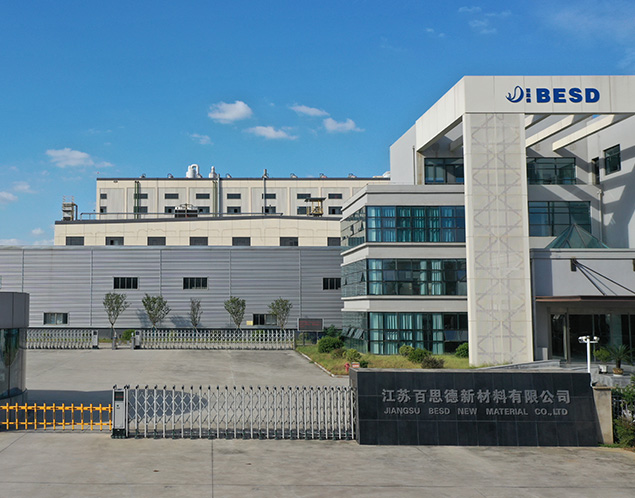
Jiangsu BESD New Material Co., Ltd. operates from the Yangzhou Chemical Industrial Park and has been producing polyester resins for powder coatings since 1998. A new project completed and commissioned in 2019 brought annual capacity to 100,000 tonnes on a site of roughly 40,000 square metres with about 27,000 square metres of buildings. The plant runs eight energy-efficient production lines including two fully automatic packing machines, and the site layout covers liquid raw material storage, raw material warehousing, reaction, preliminary treatment, inspection, packing and finished goods storage — the chain from raw material reception to shipment in one location.
The product range maps onto the chemistry discussed above: hybrid epoxy-cured polyester resins, outdoor HAA-cured polyester resin, outdoor TGIC-cured polyester resin, two-component TGIC polyester resin and isocyanate-cured polyester resin. Standard grades are available, and ODM and OEM customisation is offered for formulators who need a resin tuned to a specific additive package, cure schedule or substrate.
Quality management is certified to ISO 9001 and environmental management to ISO 14001, and the company holds invention and utility model patents alongside those certifications. For buyers assessing risk, the useful questions are concrete: which resin grade matches this acid value target, what crosslinker level does it demand, what gel time band should be agreed, how is a lot traced, and how quickly does a technical response arrive after an inquiry. Capacity of 100,000 tonnes per year matters to a wholesaler or distributor planning volume; an eight-line plant and a dedicated inspection stage matter to a coater worried about batch consistency.
For international buyers, export experience and a clear answer on delivery method and payment terms are part of the same evaluation. A supplier that can describe lead times, packing formats and documentation without escalation is usually a supplier that has done the route before.
Evaluate a resin manufacturer on its ability to explain crosslinker demand and tolerance bands, not only on price per tonne; that technical conversation predicts batch consistency better than any brochure.
Next Step: Custom Resin Development
Formulators rarely need a completely new polymer. They need a resin whose acid value, hydroxyl value, glass transition and melt viscosity already sit where their additive package expects them, so the flow agent and degassing agent do not have to compensate for chemistry that was never designed for the application. That is the practical case for custom development rather than catalogue selection.
If the application involves a tight appearance window, an unusual cure schedule, a heat-sensitive substrate or an exposure class that standard grades do not quite cover, the next step is a technical conversation about the target properties rather than a price list. Details on how that process works are available on the ODM and OEM customisation page, including how specifications are translated into a trial resin and what information the technical team needs at the start.
Start the custom conversation with the properties you need the film to deliver, not with a product code; the additive package follows from those properties.
Functional additives are the smallest line items on a powder coating formulation sheet and the largest source of variation between a line that runs smoothly and one that fights the same defect every shift. The crosslinker fixes the network, the degassing agent protects the film from its own escaping air, the flow agent buys the appearance, and the stabiliser package buys the years of service that the customer will only notice if they are missing.
The practical sequence is straightforward. Choose the curing chemistry against the exposure class. Set the crosslinker level from the resin acid value or hydroxyl value. Match the degassing and flow package to that chemistry and to the film thickness actually applied. Add stabilisers only where the part sees daylight. Write tolerance bands into the specification so that the next defect can be traced to a cause rather than argued about. Then keep the extruder melt temperature and the film build inside their limits, because that is where well-chosen additives are most often undone.
Done in that order, the additive package stops being a list of ingredients bought on price and becomes what it actually is: the part of the formulation that decides whether the coating performs in year one and still performs in year ten.


