


Content
- 1 What Are Amorphous and Crystalline Polymers?
- 2 What Controls Polymer Crystallinity?
- 3 Key Properties: Amorphous vs Crystalline Polymers Compared
- 4 Visual Comparison: How Amorphous and Crystalline Polymers Stack Up
- 5 Semi-Crystalline vs Amorphous Polymers in Engineering Applications
- 6 Polymer Crystallinity in Powder Coatings: Why Polyester Resins Are Amorphous
- 7 How to Choose Between Amorphous and Crystalline Polymers
- 8 Common Amorphous and Crystalline Polymer Examples
- 9 Final Recommendation
Imagine a powder coating line that suddenly starts producing panels with orange-peel texture, cloudy spots, and inconsistent gloss. The formulator checks the oven temperature, verifies the pigment dispersion, and re-runs the differential scanning calorimetry trace. The real problem often turns up in the resin itself: the polymer chains have begun to crystallize, or the glass transition temperature has drifted outside the range the formulation can tolerate. Understanding amorphous vs crystalline polymers properties is not a textbook exercise. It tells you why one resin stores well, flows smoothly, and cures into a glossy film, while another sinters in the bag, levels poorly, and delivers a dull surface.
Inside a polymer, the distinction comes down to chain order. Crystalline polymers pack their chains into repeating lattice structures. Amorphous polymers keep their chains in a random, entangled coil. Most real-world polymers sit somewhere between these extremes, and the balance between ordered and disordered regions dictates how the material responds to heat, load, solvent, and light.
For buyers working with a polyester resin manufacturer, this distinction affects every specification: glass transition temperature, melt viscosity, cure response, and final appearance. When a resin supplier guarantees consistent powder coating performance, what it is really guaranteeing is that the amorphous character of the resin stays stable from batch to batch. That is why a material scientist, a paint formulator, and a purchasing manager all need the same answer to the same question: which polymer state does my application actually require?
Key takeaway: The amorphous vs crystalline distinction is the root cause of most differences in polymer thermal, mechanical, and optical properties, and it directly determines powder coating resin design.
What Are Amorphous and Crystalline Polymers?
Polymers are long molecules built from repeating monomer units. Whether a polymer is amorphous or crystalline depends on how those chains arrange themselves when the material solidifies from the melt or from solution.
In a crystalline polymer, segments of the chains fold into regular, repeating arrays. These ordered regions, called lamellae, grow outward from a nucleus into larger structures known as spherulites. The repeating lattice is held together by secondary bonds such as van der Waals forces, dipole interactions, or hydrogen bonds, depending on the chemistry of the polymer. Because the chains pack efficiently, crystalline regions are denser than the surrounding disordered material.
In an amorphous polymer, the chains have no long-range order. They exist as entangled, randomly coiled molecules, like a bowl of spaghetti frozen mid-stir. There are no lamellae, no spherulites, and no melting point. When an amorphous polymer is heated above its glass transition temperature, or Tg, the chains gain enough mobility to move past one another, and the material softens gradually. Below Tg, the chains are effectively frozen in place, and the material behaves like a glass.
It is important to clarify one point: fully crystalline polymers do not exist. Chain entanglements, branching, and kinetic constraints always leave some disordered material between the crystalline regions. The correct term is semi-crystalline. The degree of crystallinity can range from nearly zero percent for a highly entangled amorphous polymer to perhaps 90 percent for a low-molecular-weight, highly regular polymer such as high-density polyethylene. Most commercial materials fall somewhere between 10 and 70 percent crystallinity.
The two regions are not independent. In semi-crystalline polymers, the amorphous phase acts as a connective tissue between crystallites, while the crystalline phase behaves like physical crosslinks. This explains why semi-crystalline polymers retain their shape above Tg: as long as the temperature stays below the crystalline melting point Tm, the crystallites hold the structure together even though the amorphous fraction has softened.
The balance between ordered and disordered regions also affects density and transparency. A crystalline phase is typically 5 to 10 percent denser than the same polymer in amorphous form. When light hits the boundaries between crystalline and amorphous zones, it scatters, making thick semi-crystalline parts hazy or opaque. Amorphous polymers, by contrast, transmit light because there are no large ordered domains with a different refractive index to scatter it.
Key takeaway: Amorphous polymers are randomly coiled and soften at Tg; semi-crystalline polymers contain ordered lamellae that melt at Tm and provide mechanical integrity above Tg.
What Controls Polymer Crystallinity?
Chain regularity is the first requirement for crystallization. Polymers with a regular, symmetric backbone, such as polyethylene, can fold into a lattice easily. Polymers with bulky side groups or random tacticity, such as atactic polystyrene, cannot crystallize at all. Tacticity refers to the spatial arrangement of side groups along the chain; isotactic and syndiotactic arrangements are regular enough to crystallize, while atactic arrangements are disordered.
Intermolecular forces also play a decisive role. Nylon, for example, crystallizes readily because the amide groups form hydrogen bonds between adjacent chains. The hydrogen bonds orient the chains and lock them into a lattice. Polyesters such as PET and PBT also crystallize, although more slowly than nylon or polyethylene, because their ester groups provide dipole interactions strong enough to promote ordering but not as strong as hydrogen bonding.
Cooling rate is the processing variable that most influences crystallinity. When a polymer melt is cooled quickly, chains do not have time to organize into lamellae, so the material solidifies with a lower degree of crystallinity. When it is cooled slowly, the chains have time to sort themselves and form larger crystallites. This is why an injection-molded part with a fast-cooling mold surface may have a glossy, amorphous skin while the slower-cooling core crystallizes. In powder coatings, the cooling profile after curing has a similar effect: fast cooling can freeze the film into a more amorphous state, while slow cooling may encourage unwanted haze or crystallization in certain resin types.
Molecular weight and branching also matter. Long chains get tangled more easily and crystallize more slowly, while short, unbranched chains move easily and pack efficiently. Branched polyethylene, for instance, has lower crystallinity than linear polyethylene because the branch points disrupt the lattice.
The thermal signature of a polymer tells you which family it belongs to. Amorphous polymers exhibit only a glass transition temperature, visible on a DSC curve as a step change in heat capacity. Semi-crystalline polymers show both a Tg and a sharp melting endotherm at Tm. The presence of a melting peak is the quickest way to confirm that a polymer has crystallinity.
Key takeaway: The degree of crystallinity is governed by chain regularity, intermolecular forces, cooling rate, molecular weight, and branching; a DSC melting peak confirms crystallinity, while a Tg-only curve indicates a fully amorphous polymer.
Key Properties: Amorphous vs Crystalline Polymers Compared
Once you know whether a polymer is amorphous or crystalline, you can predict its behavior across five property families. These are the properties that drive material selection in industrial coatings, molded parts, and engineering components.
Thermal Properties
Amorphous polymers have no true melting point. They soften continuously as temperature passes Tg. The useful service temperature of an amorphous polymer is therefore limited to a narrow window below Tg. For PVC, Tg is about 80°C; for polycarbonate, it is about 150°C. Semi-crystalline polymers, in contrast, can be used well above their Tg because the crystalline regions maintain mechanical integrity until Tm is reached. Nylon 6 has a Tg of roughly 50°C but a Tm of 220°C, which is why it survives boiling water even though its amorphous regions are rubbery at that temperature.
Mechanical Properties
Crystalline regions act as physical crosslinks and stiffen the material. Semi-crystalline polymers generally have higher tensile modulus, higher yield strength, and better creep resistance than amorphous polymers of similar chemistry. But they pay a price in toughness. Amorphous polymers absorb impact energy through chain segment motion and often have better notched impact strength. Polycarbonate is famous for its impact toughness, while acetal is stiffer but more notch-sensitive. When a part will see repeated impacts or rough handling, amorphous polymers are often the safer choice.
Optical Properties
Even a small amount of crystallinity scatters light. Semi-crystalline parts appear translucent or white because light is refracted at the boundaries between crystalline and amorphous regions. Amorphous polymers are transparent when no fillers or pigments are added. That is why clear bottles are made from amorphous PET or polycarbonate, while milk jugs made from high-density polyethylene are translucent. In powder coatings, transparency matters less than gloss, but a resin that begins to crystallize will produce a dull, hazy film.
Chemical Resistance
Solvent molecules penetrate a polymer through the free volume between chains. Amorphous polymers, with their loose, random packing, have more free volume and are more vulnerable to solvent attack and stress cracking. Crystalline regions, by contrast, are so tightly packed that solvent molecules cannot enter. Semi-crystalline polymers such as polyethylene, polypropylene, nylon, and acetal are used for chemical tanks, fuel-system components, and pump housings for this reason. Amorphous polymers need careful application selection when solvents or aggressive chemicals could be present.
Density and Shrinkage
Crystalline chains pack more efficiently, so semi-crystalline polymers have higher density at the same molecular weight. The higher packing also causes more volumetric shrinkage when the melt solidifies. Semi-crystalline injection moldings shrink between 1.5 and 2.5 percent; amorphous moldings shrink only 0.3 to 0.7 percent. This makes amorphous polymers easier to hold to tight dimensional tolerances, and it makes warpage control more challenging for crystalline materials.
| Property | Amorphous Polymers | Semi-Crystalline Polymers |
|---|---|---|
| Thermal behavior | Tg only; no melting point; narrow service window | Tg and Tm; usable above Tg up to Tm |
| Optical clarity | Transparent | Hazy or opaque |
| Impact toughness | Higher notched impact resistance | Lower unless toughened with additives |
| Chemical resistance | Weaker; prone to solvent stress cracking | Stronger; tight packing blocks solvents |
| Mold shrinkage | Low, 0.3 to 0.7 percent | High, 1.5 to 2.5 percent |
| Density | Lower | Higher |
Key takeaway: Crystalline polymers excel in heat, stiffness, and chemical resistance; amorphous polymers excel in transparency, toughness, and dimensional precision.
Visual Comparison: How Amorphous and Crystalline Polymers Stack Up
Ranking the two families on a 1-to-10 scale makes the trade-offs easier to weigh. The chart below compares six properties that dominate material selection for industrial applications. Crystalline polymers score higher in thermal resistance and chemical resistance, two attributes tied directly to efficient chain packing. Amorphous polymers score higher in transparency, impact strength, and dimensional stability, three attributes tied to random chain configuration. These are relative ratings, not absolute test values, but they reflect the patterns consistently found in polymer data sheets.
Relative Property Scores of Amorphous vs Crystalline Polymers
Two gaps stand out immediately. Optical transparency gives amorphous polymers a score of 9 against only 3 for crystalline polymers, which explains why lenses, light guides, and clear medical components come from amorphous families. Thermal resistance shows the opposite picture: crystalline polymers score 9, reflecting their ability to remain mechanically stable above Tg. A gear running at 120°C would soften if molded from an amorphous polymer with a Tg near 100°C, but it would hold shape in a semi-crystalline grade such as nylon or PEEK. Chemical resistance follows the same trend, 8 points for crystalline polymers versus 5 for amorphous ones. Tightly packed lamellae leave less free volume for solvent molecules to infiltrate. Impact strength is where amorphous polymers earn their toughness reputation with a score of 8 against 5. Entangled molecular coils act like tiny springs, absorbing energy before a crack can propagate. Dimensional stability also favors amorphous polymers, because the absence of crystallization eliminates the shrinkage that follows solidification. Ease of processing rounds out the picture: amorphous polymers offer wider processing windows, while semi-crystalline grades require precise control of mold and cooling temperatures. For a powder coating formulator, the message is direct: the amorphous character of a polyester resin delivers the leveling, storage stability, and gloss that a smooth finish depends on. For an engineer designing a load-bearing part, the same chart points to crystalline materials whenever heat, chemicals, and long-term creep dominate the risk list.
Key takeaway: No single polymer family wins on every property; the right choice depends on which performance demand is critical for the application.
Semi-Crystalline vs Amorphous Polymers in Engineering Applications
Real engineering parts tend to polarize around the two families. Semi-crystalline polymers dominate applications where load, heat, and chemicals combine. Amorphous polymers dominate applications where clarity, impact, and easy thermoforming matter. The table below summarizes the typical usage patterns, and the paragraphs that follow explain the processing logic behind them.
Semi-Crystalline Polymers
|
Amorphous Polymers
|
Processing behavior differs just as clearly. Amorphous polymers shrink less and therefore produce parts with tighter tolerances and less warpage. They also form stronger weld lines, because molecular diffusion across the weld zone is easier when no crystalline order must be re-established. Semi-crystalline polymers, by contrast, tend to create weak weld lines when two melt flow fronts meet inside a mold. Designers who place a weld line in a high-stress location must account for this.
Fatigue performance is one of the few areas where semi-crystalline polymers are clearly superior. The crystalline lattice resists crack initiation under cyclic load, which is why acetal gears outlast amorphous gears in repeated-duty applications. Amorphous polymers, however, have better damping, which helps in applications that absorb vibration rather than transmit it. The two families are therefore complementary, not interchangeable.
Key takeaway: Use semi-crystalline polymers for load-bearing, chemical-exposed, high-heat parts; use amorphous polymers for transparent, impact-resistant, dimensionally precise parts.
Polymer Crystallinity in Powder Coatings: Why Polyester Resins Are Amorphous
Powder coatings sit at an interesting intersection of the amorphous-crystalline spectrum. The binder in most powder coatings is a polyester resin, and the polyester resins used in powder coating formulations are designed to be amorphous. This is not an accident; it is a requirement. A powder coating must survive storage as a free-flowing powder, then melt, flow, and crosslink into a continuous film inside an oven. If the resin were highly crystalline, the powder would sinter into clumps at warehouse temperatures, and the film would cool to a hazy, uneven surface.
The amorphous nature of polyester resin shows up in its thermal signature: a clear Tg and no melting endotherm on a DSC trace. This means the resin can be formulated to stay glassy at room temperature, preventing the powder particles from sticking together, while melting and flowing smoothly as soon as the part enters the curing oven. The random chain structure also gives the molten film excellent leveling behavior and a smooth, high-gloss finish after crosslinking.
Crystalline polyesters do exist, and some powder coating recipes use small amounts of crystalline polyester components to speed up early flow or modify the glass transition. But they are the exception, not the rule. For the main binder, a fully amorphous polyester with controlled Tg, acid number, and melt viscosity is the standard because it provides the broadest processing window and the most reproducible appearance.
The storage stability of a powder coating depends on keeping the resin Tg comfortably above warehouse temperatures. Most amorphous polyester resins for powder coatings have a Tg between 50 and 70°C. If a resin supplier lets the Tg drift downward, the powder can block and sinter during summer shipping. If the Tg is too high, the coating may not level sufficiently in the oven. This balance is a daily concern for powder coating manufacturers, and it is defined entirely by the amorphous character of the resin. The crystalline fraction matters in another way: overbake or slow cooling can sometimes induce partial crystallization of certain resin components, producing a film with matte spots. Careful resin design keeps the whole system amorphous during the entire cure window.
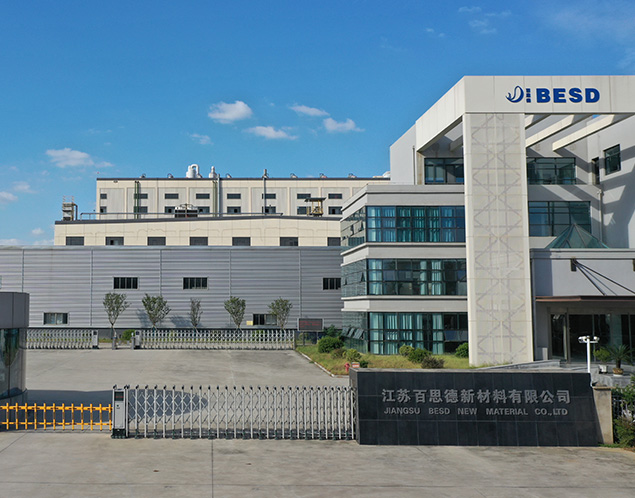
For buyers who source resin from a direct manufacturer, these fundamentals directly affect the performance of the finished coating. BESD (Jiangsu Besd New Material Co., Ltd.) produces a full range of amorphous polyester resins for powder coatings, including hybrid epoxy-cured polyesters, outdoor HAA-cured resins, outdoor TGIC-cured resins, two-component TGIC systems, and isocyanate-cured resins. The company operates from Yangzhou Chemical Industrial Park with an annual capacity of 100,000 tons, serves customers in multiple export markets, and holds ISO9001 and ISO14001 certifications. Raw material selection, production reactor control, and final inspection are managed in-house, which is exactly the kind of supply chain visibility a wholesale buyer needs when powder coating performance is non-negotiable.
 Hybrid Epoxy-Cured Polyester Resin for Powder CoatingsThis amorphous polyester resin is designed for hybrid epoxy-cured powder coating systems, offering balanced performance for interior applications. Its production is backed by in-house quality control, supporting consistent batches for wholesale buyers.View Product → TGIC-Cured Polyester Resin for Outdoor Powder CoatingsA polyester resin formulated for TGIC-based powder coatings, providing durable outdoor performance with good weathering resistance. Buyers evaluating long-lasting finishes will find this option relevant given the manufacturer's emphasis on batch consistency.View Product → HAA-Cured Polyester Resin for Reduced Coating DefectsThis HAA-cured polyester resin cures quickly and helps minimize common coating defects like blistering and sagging. It suits manufacturers seeking efficient production and higher coating quality, with production supported by documented process controls.View Product →
When selecting a polyester resin wholesaler or contract manufacturer, it is always worth asking how the Tg is controlled and what quality checks protect batch consistency. A resin that remains truly amorphous, with a stable Tg, predictable acid number, and consistent melt viscosity, will deliver the storage stability, flow, gloss, and weathering performance that powder coating customers expect. Asking those questions is easier when the supplier can document its production process and quality system rather than simply promising results.
Key takeaway: The amorphous character of a polyester resin is what gives a powder coating its storage stability, smooth flow, and reproducible gloss; verify Tg consistency when qualifying a resin supplier.
How to Choose Between Amorphous and Crystalline Polymers
When you face a new material selection, the first step is to decide which property will dominate the application. The checklist below is not a substitute for testing, but it narrows the options quickly.
- Define the maximum continuous service temperature. If the part must hold load above 100°C, start with semi-crystalline options.
- List the chemicals the part will contact. Aggressive solvents and fuel favor crystalline polymers.
- Check whether optical clarity is required. Only amorphous polymers offer inherent transparency.
- Determine the dimensional tolerance. Low-shrinkage amorphous polymers are easier to hold to tight tolerances.
- Assess the impact and fatigue. Notched impact favors amorphous; cyclic loading favors crystalline.
- Evaluate the processing route. Amorphous polymers are more forgiving in injection molding and extrusion.
- Review cost and availability. Commodity crystalline polymers such as PE and PP are inexpensive, but high-performance crystalline PEEK is costly; compare across families.
For powder coating formulators, the choice is not between amorphous and crystalline as separate raw materials, but rather choosing the right amorphous polyester resin for a given curing chemistry. A TGIC-cured system used for exterior architecture needs a resin with high Tg and good weathering. An HAA-cured system needs a resin that balances reactivity and flow. A hybrid epoxy-cured system offers lower cost and good interior performance. Understanding where the resin sits on the amorphous spectrum helps the formulator set the correct oven temperature and cure time.
High Heat
Choose semi-crystalline:
PEEK, PA, POM, or PPS.
Their crystalline phase
holds structure above Tg.
Chemical Exposure
Choose semi-crystalline:
PE, PP, PVDF. Dense
lamellae resist solvent ingress.
Optical Clarity
Choose amorphous:
PC, PMMA, PS.
No spherulites means
no light scattering.
Impact Toughness
Choose amorphous:
PC and ABS absorb impacts
better than most crystalline
alternatives.
Key takeaway: Define the dominant service condition first; the amorphous-crystalline trade-off then narrows the material family, and only cost, supply, and processing validate the final choice.
Common Amorphous and Crystalline Polymer Examples
The table below lists representative polymers in each family. It is a useful reference when comparing materials from different suppliers, including a polyester resin manufacturer offering resin for powder coatings.
| Polymer | Type | Typical Applications |
|---|---|---|
| Polycarbonate (PC) | Amorphous | Transparent housings, lenses, safety glazing |
| PMMA (Acrylic) | Amorphous | Display covers, light guides, signage |
| Polystyrene (PS) | Amorphous | Disposable parts, packaging, optics |
| ABS | Amorphous | Appliance housings, instrument panels |
| PVC | Amorphous | Pipes, profiles, cable insulation |
| Polyester resin (powder coating) | Amorphous | Powder coating binders for indoor and outdoor use |
| Polyethylene (PE) | Semi-crystalline | Bottles, tanks, packaging films |
| Polypropylene (PP) | Semi-crystalline | Auto parts, living hinges, chemical tanks |
| Nylon (PA 6, PA 66) | Semi-crystalline | Gears, bearings, cable ties, engine parts |
| Acetal (POM) | Semi-crystalline | Precision gears, bushings, fasteners |
| PET / PBT | Semi-crystalline | Bottles, automotive connectors, electrical parts |
| PEEK | Semi-crystalline | Aerospace, medical implants, oil and gas components |
The list makes an important point: the same chemical family can appear on both sides of the spectrum. PET, for example, is amorphous when quenched quickly to make clear bottles, but it crystallizes when cooled slowly in an injection mold. This is why processing conditions deserve the same attention as polymer grade when designing parts and specifying materials.
Key takeaway: Crystallinity is not fixed by chemistry alone; processing conditions decide whether a polymer like PET behaves amorphous or semi-crystalline, so the entire thermal history must be controlled.
Final Recommendation
The amorphous vs crystalline distinction is not just polymer chemistry trivia. It is the key that unlocks predictable thermal, mechanical, optical, and chemical performance. For powder coating specifiers, it explains why polyester resin quality controls the entire production process, from powder storage to oven cure to outdoor weathering.
When you evaluate a polyester resin manufacturer, ask the questions that matter: What is the Tg of the resin? How consistent is the batch-to-batch acid number? Can the supplier provide technical documentation and a fully integrated production chain? A direct manufacturer with ISO9001 and ISO14001 certification, a large-capacity plant, and a transparent factory process will answer these questions with data, not promises.
Useful resources:
- Explore powder coating application areas to see how amorphous polyester resins perform in automotive, building materials, communication equipment, household appliances, and more.
- Review company history and manufacturing capabilities to understand how a 26-year polyester resin manufacturer builds quality into every batch.
Key takeaway: Selecting the right polymer family is a data-driven decision; for powder coatings, choose a mature amorphous polyester resin supplier with consistent Tg, reliable quality, and documented manufacturing capability.


