


Content
- 1 Amorphous vs Crystalline Polymers: Definitions and Structure
- 2 Amorphous vs Crystalline Polymers: Key Differences at a Glance
- 3 Visualizing the Property Profile
- 4 Amorphous vs Crystalline Polymers: What It Means for Powder Coatings
- 5 Amorphous vs Crystalline Polymers: Selection Criteria for Real Applications
- 6 What to Look for in a Polymer Supplier
- 7 Frequently Asked Questions: Amorphous vs Crystalline Polymers
- 8 Related Resources
The choice between amorphous vs crystalline polymers is one of the first decisions a design engineer or procurement specialist faces when selecting a plastic material. Crystallinity determines whether the material will be transparent or opaque, how it responds to impact and solvents, and how much it shrinks during processing. Amorphous polymers are known for clarity, impact resistance, and predictable shrinkage. Crystalline polymers are favored for stiffness, chemical resistance, and heat tolerance. The practical implication is that neither family is universally superior; the selection depends on the application, manufacturing process, and cost target.
Key takeaway: Crystallinity is not an absolute label; most crystalline polymers are actually semi-crystalline, and the balance of ordered and disordered regions controls real-world performance.
Amorphous vs Crystalline Polymers: Definitions and Structure
An amorphous polymer has molecular chains arranged in a random, tangled structure with only short-range order. Because there is no regular lattice, amorphous polymers do not have a sharp melting point; they soften gradually above their glass transition temperature (Tg). Typical amorphous plastics include polystyrene, polycarbonate, and acrylic, although many polyester resins used in powder coatings are also formulated to be amorphous.
A crystalline polymer, more precisely a semi-crystalline polymer, contains regions where chains fold into an ordered crystalline lattice. Those crystalline regions are dispersed within amorphous domains. The crystalline portion gives the material a melting point (Tm), higher stiffness, and better chemical resistance, while the amorphous portion retains impact resistance and ductility. Examples include polyethylene, polypropylene, nylon, and PET.
For industrial buyers, the distinction matters because it changes how a material behaves in injection molding, extrusion, and coating applications. A powder coating resin with controlled crystallinity must balance flow, leveling, and storage stability.
Key takeaway: All crystalline polymers contain amorphous regions; the microstructure, not the product name, determines the final performance envelope.
Amorphous vs Crystalline Polymers: Key Differences at a Glance
Use the following comparison as a quick reference when you evaluate resin options for a new project. The table highlights the properties that most often influence part design.
| Property | Amorphous Polymers | Crystalline Polymers |
|---|---|---|
| Molecular order | Random, no long-range order | Ordered crystalline regions in an amorphous matrix |
| Clarity | Usually transparent | Usually opaque or translucent |
| Thermal behavior | No melting point; softens above Tg | Definite melting point Tm; Tg still present |
| Shrinkage | Lower and more predictable | Higher, can be anisotropic |
| Chemical resistance | Weakness to solvents and stress cracking | Generally better resistance |
| Impact strength | Often good | Depends on amorphous content |
| Fatigue resistance | Poor | Better |
This table reflects typical behavior, but actual values depend on molecular weight, additives, and processing conditions.
Key takeaway: If clarity and dimensional stability matter more than chemical resistance and stiffness, an amorphous polymer is often the safer choice; for load-bearing and chemical exposure, crystalline polymers usually win.
Visualizing the Property Profile
Property profiles help translate polymer science into practical selection. Amorphous and crystalline polymers rarely fit a simple better-or-worse comparison. Instead, their relative scores reveal trade-offs that matter at the part level. A resin with excellent clarity may also have weaker solvent resistance. A resin with high stiffness may shrink more in a mold. The chart below plots approximate performance ratings to illustrate those trade-offs.
| Property | Amorphous | Crystalline |
|---|---|---|
| Clarity | ||
| Chemical resistance | ||
| Heat resistance | ||
| Impact resistance | ||
| Shrinkage control | ||
| Fatigue resistance |
Several conclusions stand out from this profile. First, clarity is the clearest advantage of amorphous polymers, with a score of 90 versus 30 for crystalline materials. That is why transparent lenses, medical devices, and display covers use amorphous resins almost exclusively. Second, crystalline polymers dominate in heat resistance and chemical resistance, which explains their use in automotive underhood parts, chemical containers, and pipe fittings. Third, amorphous polymers provide better impact resistance and dimensional control, making them easier to process at low shrinkage and to hold tight tolerances. Crystalline polymers, by contrast, have higher fatigue resistance but require more attention to cooling and mold design. For powder coating applications, the balance is different because the resin is only one component of the coating system. An amorphous polyester resin can deliver smooth films, high gloss, and good storage stability, while a semi-crystalline polyester may offer better hardness or block resistance if formulated correctly. The practical implication is that material selection cannot be based on crystallinity alone. You need to combine these property scores with the exact demands of the application, such as UV exposure, solvent contact, and mechanical load. A supplier with formulation experience can help you weigh these trade-offs before you commit to a specific polymer.
Key takeaway: A balanced view of amorphous and crystalline polymer properties prevents costly mismatches between material capabilities and service requirements.
Amorphous vs Crystalline Polymers: What It Means for Powder Coatings
In the powder coating industry, most polyester resins are intentionally formulated to be amorphous. Amorphous outdoor polyester resins wet pigments effectively, flow into a smooth film, and produce the high gloss that architectural and appliance customers expect. If a resin develops too much crystallinity, the powder can become sticky, harder to grind, and more difficult to level during curing. This is why hybrid epoxy-cured polyester resins and TGIC/HAA-cured resins are usually amorphous, even when they differ in curing chemistry.
For formulators, the most important measurable property is the glass transition temperature. A resin with a Tg that is too low will sinter in the bag or in the reclaim system. A resin with a Tg that is too high may require more energy to melt and flow. An experienced resin manufacturer can adjust the monomer ratio to keep Tg in the working range while maintaining amorphous behavior.
Key takeaway: For powder coatings, amorphous behavior is usually a feature because it supports gloss, leveling, and reliable curing; crystalline behavior is less common and typically introduced only for specific performance targets.
Amorphous vs Crystalline Polymers: Selection Criteria for Real Applications
The best choice depends on specific requirements. Use the following selection guide to compare material behavior before you make a purchase decision.
Choose amorphous when
|
Choose crystalline when
|
For coated parts, the polymer substrate and the coating resin may operate in different regimes. A metal part with a powder coating does not need the resin itself to be crystalline, but an amorphous resin can still deliver the film properties needed for outdoor durability. Therefore, do not simply apply a plastics selection rule to a coating system.
Talk to a polyester resin supplier about Tg, reactivity, and rheology. Those parameters determine how the powder flows, cures, and performs outdoors. A semi-crystalline resin may be useful for a specific matting effect, but standard TGIC-cured polyesters are usually the safer starting point.
Key takeaway: Match the polymer type to the most demanding service condition; use amorphous materials where appearance and impact dominate, and consider crystalline materials only when chemical, wear, or heat resistance cannot be achieved otherwise.
What to Look for in a Polymer Supplier
Whether you need an amorphous polyester resin, a semi-crystalline specialty resin, or a custom formulation, the supplier's process control is as important as the chemistry. Look for a resin manufacturer with documented quality systems, consistent production capacity, and a responsive technical team. A supplier that offers ODM/OEM customization can adjust hydroxyl value, acid value, and Tg to match your curing agent and application conditions.
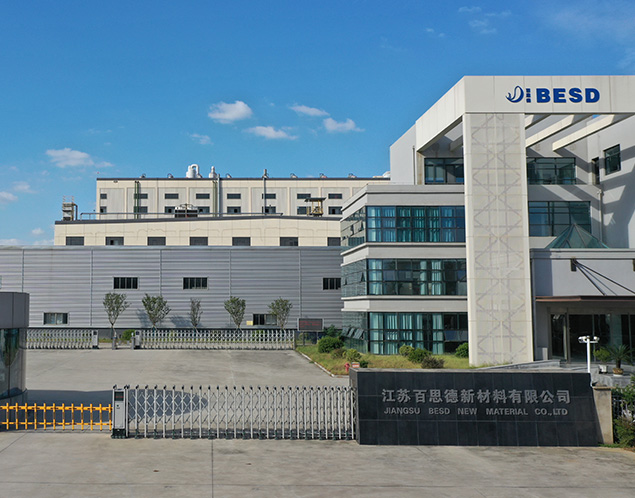
BESD is a polyester resin manufacturer with 26 years of industry experience and an annual capacity of 100,000 tons. The production facility includes automated lines, raw material storage, in-process inspection, and finished goods warehousing. ISO 9001 and ISO 14001 certifications support traceability and environmental management. Company history and quality-control details are available on the official website.
For buyers who evaluate price and delivery, ask whether the supplier can support large-volume programs without changing batch quality. A direct manufacturer can often respond faster than a trader or wholesaler because it controls the entire synthesis and quality-control loop.
Key takeaway: Choose a polymer supplier that combines technical flexibility with manufacturing scale, because batch-to-batch consistency directly affects your coating or molding process.
Frequently Asked Questions: Amorphous vs Crystalline Polymers
What is the main difference between amorphous and crystalline polymers?Amorphous polymers have randomly ordered molecular chains and no melting point, while crystalline polymers contain ordered regions and exhibit a melting point. This structural difference leads to differences in clarity, chemical resistance, shrinkage, and heat tolerance. |
Which polymer type has better chemical resistance?Crystalline polymers generally have better chemical resistance because tightly packed crystalline regions reduce solvent penetration. Amorphous polymers are more vulnerable to solvent attack and stress cracking, especially under load. |
Are polyester resins amorphous or crystalline?Most powder coating polyester resins are formulated to be amorphous, which supports gloss, leveling, and storage stability. Semi-crystalline polyesters exist for specialized applications, but they are less common in classic powder coating formulations. |
How should I choose between amorphous and semi-crystalline polymers for powder coatings?For smooth, high-gloss finishes with reliable curing, start with an amorphous resin. If you need a matte texture or unusual mechanical behavior, ask your polyester resin manufacturer whether a semi-crystalline option can be formulated without hurting storage stability. |
Key takeaway: The right polymer choice depends on the coating chemistry and the part's service environment, not just on whether the resin is classified as amorphous or crystalline.
Related Resources
For more context on this topic and on the supplier behind your polyester resin options, use the links below.
| About the polyester resin manufacturer | Common supplier and purchasing questions |
Key takeaway: Start with the manufacturer's own documents and FAQ when you need detailed quality, customization, or delivery information.


